Friday, April 30, 2010

The Synagogues of Prague

Wednesday, April 7, 2010 (Part 4):

Like many large cities in eastern Europe, Prague has a long history of being home to a large Jewish population. And like other such cities, the Jews of Prague were targeted for extermination as part of Hitler's campaign to destroy this race of people. We had tried to tour the Jewish Quarter of Prague on our first day here, but had to wait two days until the synagogues re-opened to the public following a period of Jewish holidays.

The Jewish Quarter has a very organized tour route and audio guide, and we followed it completely. We had to wait in a long line to purchase our tickets, but once we got started we found it all fascinating. We visited a total of five synagogues, a Jewish cemetery and a ceremonial hall. It took us four hours!

The tour began at the Pinkas Synagogue. This is a very old synagogue -- many of hundreds of years old. It is now a permanent memorial to the Prague Jews who were exterminated at the death camps during World War II. On the interior walls of this synagogue are hand-inscribed the names of the more than 77,000 Jews from Prague who were killed during the war. This is a very moving monument. Conceptually, it reminded me of the Vietnam War Memorial on the Mall in Washington, D.C. The names are arranged alphabetically. The family name is in red block type, followed by each family member's first name, date of birth and date sent to the death camps. Stars also denote the beginning and ending of a family grouping.
Also of note, these names were first inscribed in the early 1950s. When the city came under communist influence and was occupied by the Russians in the late 1950s, 1960s and 1970s, the names were obliterated. When the city emerged from communist rule in the 1970s, the names were inscribed all over again!

Pictures were prohibited inside any of the synagogues, so I have selected here (i) a picture of an interesting building on one of the central street corners in the Jewish Quarter that featured a nice statue on the exterior corner of the fourth floor, and (ii) a picture of the clock tower on top of the Jewish Town Hall within the Jewish Quarter.

An Interesting Detour


Wednesday, April 7, 2010 (Part 3):

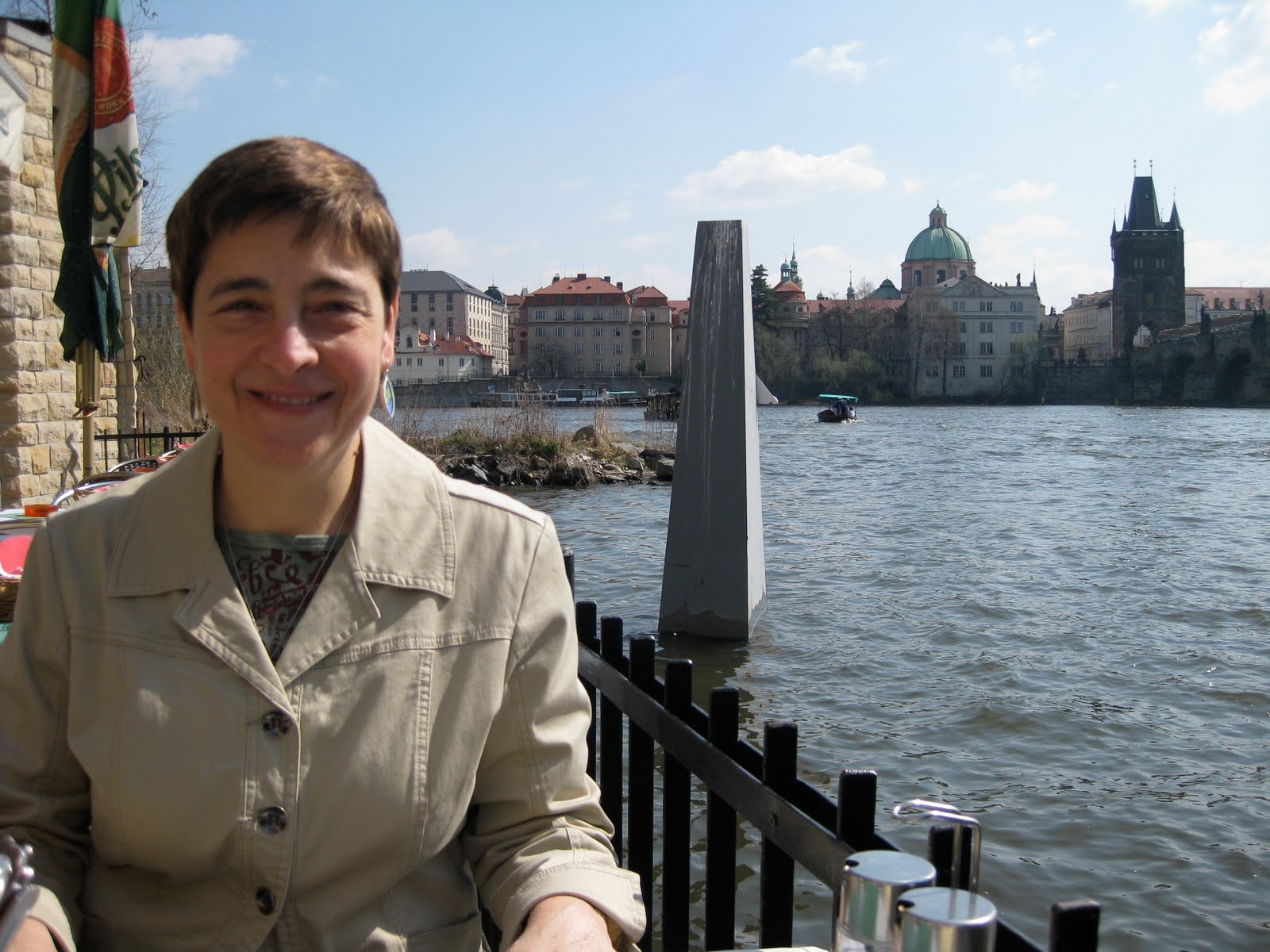
Our lunch today was at another restaurant just below the Charles Bridge at the river's edge. We enjoyed our salads while sitting in the sun on a beautiful terrace. And following lunch, we walked under the Charles Bridge and came upon two really interesting sites. The first was a section of railing along a walkway that was adorned with hundreds of locks. Apparently, it is a custom here for couples to visit this walkway and leave behind a lock representing their love for each other. And leaving a lock here is supposed to ensure a long, happy life together for the couple. Many of the locks are engraved with names and dates. This struck me as a lovely custom.

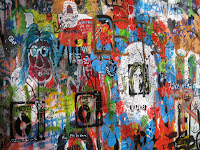
And just around the corner from the walkway adorned with locks is "Lennon's wall." This is a 60 or 70 foot stretch of wall that is chock full of graffiti. And in the middle of the wall is a graffiti drawing of John Lennon. The wall was very colorful, and it was a lot of fun to walk along and pick out words and phrases. It is also quite the tourist attraction. There were a lot of other people walking along its expanse.

Thursday, April 29, 2010

Financial Considerations

Wednesday, April 7, 2010 (Part 1):

One of the real advantages experienced during this trip was that the US dollar was strong in value compared to the Euro and other European currencies. We dealt with three different currencies during our travels: (i) the Danish kroner in Denmark, (ii) the Czech crown in Prague, and (iii) the Euro in Vienna. In Prague, in particular, it was difficult (for me, anyway) to really keep track of how much things cost. The Czech crown is a high denomination currency. I think the exchange rate was something like 20 Czech crowns to a single US dollar. So 100 crowns was equal to $5. And so the numbers get really high really fast. It'
s not uncommon to be carrying 1000-crown and 2000-crown bills. On top of the great exchange rate, everything in Prague was just plain cheap.

What was most hard to adjust to, however, was that the great majority of merchants only take cash. As a result, o
n the second day in the city, we ran into an unexpected problem. We were enjoying a lovely lunch at a restaurant by the river's edge, when the waiter brought our check. I pulled out a credit card, and he advised us that they only took cash. Katherine and I looked at each other. We didn't have that much cash on us. So we started scrounging through our purses.

We did come up with the cash that we needed, but that left us with very little, and I'd left my ATM card back at the hotel (about a mile away). We had enough money left to get into one more site on our list, but then we had to pass on a couple other places we had planned to see that afternoon because we simple had no more money! We had no choice but to head back to the hotel. Needless to say, once I was in possession of my ATM card, we made a bee-line for an ATM. From that point forward, we made sure we always had plenty of cash on hand.


Tuesday, April 27, 2010

Dinner and Dessert in Prague

Tuesday, April 6, 2010 (Part 9):

We were not very adventurous in our dining while in Prague, but we ate well. Our first night, we ate at an italian restaurant. There are a lot of italian restaurants in Prague, and we were very pleased with our choice. I had pasta bolognese and Katherine had mushroom gnocchi. We also shared a bottle of red wine. Katherine is now 21 after all.


The second and third nights, we ate at two different cafes around the Old Town Square. The food was surprisingly good. We typically ordered salads of some kind, and one night we both enjoyed soup - a lobster bisque for Katherine and veal tortellini for me.
Yum! (So much for my diet.)

And on our second night, following the marionette show, we treated ourselves to an ice cream sundae, which we shared. There was an ice cream parlor on the first floor of our hotel and we'd been walking by it for two days. On this night, we finally broke down. But it was worth it!


Another treat that Katherine enjoyed was a fried donut-type confection, covered in cinnamon and sugar. They were being sold by a number of vendors as part of the Easter fair that was set up in the Town Square.

Mozart's "Don Giovanni" - Marionette Style

Tuesday, April 6, 2010 (Part 8):

One of the things for which Prague is well known is its marionettes. There are tourist shops everywhere selling marionettes of all styles, figures and sizes. They were even selling Obama marionettes! And there are several theaters in Prague that exist for the sole purpose of presenting marionette shows. Perhaps the longest running and most well know of these is "Don Giovanni" presented by the National Marionette Theater.

We picked up our tickets for the show early in the day and learned that it was "open seating" with the doors opening 30 minutes before curtain time. So, of course, we had to get there 30 minutes before curtain time so that we could get the best possible seats. We did, and we were rewarded with seats in the center of the second row.

As you might expect, this was a fairly intimate theater. I'm guessing that it could seat maybe 100 people. The stage itself is relatively small. The marionettes are about 3-feet tall, and the puppet-masters stand behind the set, and hang over it from the top. We could see their hands and their upper bodies. It looked a lot like the marionette show that we all know and love from the movie "Sound of Music."

The show was fabulous -- thoroughly entertaining. It started with a conductor marionette who provided the comic relief throughout the show. We then proceeded to a fairly full presentation of Mozart's opera, "Don Giovanni." Katherine and I didn't know the story, so we read a summary of it online earlier in the day. It's a pretty dark opera. Don Giovanni is the ultimate villain. He as no redeeming qualities as far as I could tell. But seeing this opera performed by puppets, obviously, added a completely new dimension. It was great fun.


Monday, April 26, 2010

The Loreto - A Place of Pilgrimage

Tuesday, April 6 2010 (Part 7):

Following lunch, we took a bit of a hike up past the castle and on to The Loreto. The Loreto was built in 1626. It's purpose was to house a replica of Santa Casa of Loreto, which is believed to be the house of the Virgin Mary in Loreto, Italy. The complex consists of a square building (referred to as the cloisters) building built around a courtyard in which sits a replica of Santa Casa. [Once again, taking photos was prohibited.]

The Loreto had a really wonderful audio tour which Katherine and I both thoroughly enjoyed. This complex was commissioned by a woman who wanted to promote the legend of this house. For hundreds of years, the Loreto has been maintained by a Franciscan order of monks.

Also located within the Loreto are several chapels (in each of the four corners) and a small church as well as two large statues and a "treasury." And finally, there is a bell tower that plays a particular hymn several times a day. We were disappointed that they did not play during the time that we were there.

The small church was particularly nice and had a number of impressive gold/gilt statues. The treasury was also impressive -- housing several bejeweled "monstrances" (which we had to look up to understand its purposes -- it houses the host for communion) and other reliquary.

A Great Lunchtime Setting

Tuesday, April 6, 2010 (Part 7):

Following our tour of several churches, we walked across the Charles Bridge once again to get to the western part of the old town area of the city. As we were walking across the bridge, we noticed that there were several restaurants located on the western side of the river. It was a beautiful day, and it struck as as the perfect idea to find our way to one of these restaurants for lunch. Additionally, when Katherine was in Prague the previous week, she was on a walking tour where they were shown the smallest "street" in Prague. That street was on the western side of the river and led to a restaurant at the water's edge. And so that became our destination.

It took a little exploring but, without too much difficulty, we found our way to this very small "street" that led to the river. Of course, it really isn't a street a tall. It's no more thanan incredibly small alleyway -- about the width of a single person. In fact, it can only be traversed one person in one direction at a time. There is even a stop light -- with red and green lights -- to tell people when they can proceed up or down. The lights are really not necessary. The length of this passageway is no more than about 75 feet. But it was a cute touch.

We had a lot of fun making our way down the alley and finding ourselves in the outdoor seating area of a restaurant. The seating was in two
sections, an upper and a lower section. Because we were arriving before the lunch hour, we had a wonderful selection of seating options. We chose a table directly on the water. It was great! We enjoyed a very nice lunch of salads and we took advantage of our relaxing break to write a few postcards.